About
Speculative futures, parafictions and notions of time are at the centre of many Biennial projects, including those presented by Lindsay Katsitsakatste Delaronde, Regina de Miguel and Andrés Ramírez Gaviria.
To program Sources (Toronto, 2026), a site-specific light installation at the University of Toronto, Andrés Ramíres Gaviria transformed astronomical radio signals —many emitted by pulsars and quasars billions of years ago — into a dynamic sequence of light.
Lindsay Katsitsakatste Delaronde’s half-human half-cyborg being Soul Hex (2026), created during an uninhabitable future where human beings are living underground and in mountains, combines ancient and contemporary Indigenous epistemologies as tools for imagining a framework for future generations to unpack and consider.
Living in what the artist calls “the in-between” during a plague, the protagonist in Regina de Miguel’s Poisoned Waters, Comets Never Seen Again, A Gathering of Suicides (2026) finds herself stranded on the terraformed planet Tornus while awaiting assignment for a new mission. In this desolate world, swamps are an interface connecting to voices from another time.
These shifting temporalities and translations of deep time shift, obfuscate and pull us in and out of a linear chronology. Join TBA Curator Allison Glenn for a moderated discussion with these artists, where they will dive into notions of time, science fiction, Indigenous epistemologies and speculative futures.
Co-presented by the Toronto Biennial of Art and Harbourfront Centre and made possible with the generous support of RBC, Eleanor and Francis Shen and the Women Leading Initiative.
About Allison Glenn

Allison Glenn is a New York-based curator and writer focusing on the intersection of art and public space, through biennials and special projects, public art and major new commissions by a wide range of contemporary artists. For over fifteen years, Glenn has been devoted to realizing ambitious and experimental exhibitions and site-specific artist projects with artists working across the globe. She is Curator of the 2026 Toronto Biennial of Art, opening September 26, 2026.
She is one of the curators of Centro América Red de Arte (CARA), opening November 2026 in Guatemala City. Previous curatorial roles include Artistic Director of The Shepherd, Curator of Special Projects for Untitled Miami Beach 2025. Co-Curator of Counterpublic Triennial 2023, Visiting Curator at University of Tulsa, Senior Curator at New York’s Public Art Fund, Associate Curator of Contemporary Art at Crystal Bridges Museum of American Art. At Crystal Bridges, Glenn shaped how outdoor sculpture activates and engages Crystal Bridges’ 120-acre campus through a series of newly fabricated commissions, touring group exhibitions and long-term loans. She gained broad acclaim for organizing the path-breaking 2021 exhibition Promise, Witness, Remembrance at Louisville, Kentucky’s Speed Art Museum. Glenn also held a curatorial and publications role with Prospect New Orleans Triennial and was a Curatorial Fellow with the City of Chicago’s Department of Cultural Affairs and Special Events.
Her writing has been featured in catalogues published by Sharjah Art Foundation, The Los Angeles County Museum of Art, Counterpublic Triennial, Prospect New Orleans triennial, Princeton Architectural Press, Crystal Bridges Museum of American Art, Studio Museum in Harlem, and more, and she has contributed to Artforum, ART PAPERS, Brooklyn Rail, Hyperallergic, ART21 Magazine, Pelican Bomb, Ruckus Journal and Newcity, amongst others. Glenn has been a visiting critic, lecturer and guest speaker at a number of universities, including The University of Tulsa, University of Pennsylvania, School of the Art Institute of Chicago and Pacific Northwest College of Art.
She is a member of Madison Square Park Conservancy’s Public Art Consortium Collaboration Committee and is an Advisory Board member for ARCAthens, a curatorial and artist residency program based in Athens, Greece, New Orleans, LA and The Bronx, New York. Allison received dual Master’s degrees from the School of the Art Institute of Chicago in Modern Art History, Theory and Criticism and Arts Administration and Policy and a Bachelor of Fine Art Photography with a co-major in Urban Studies from Wayne State University in Detroit.
About Lindsay Katsitsakatste Delaronde
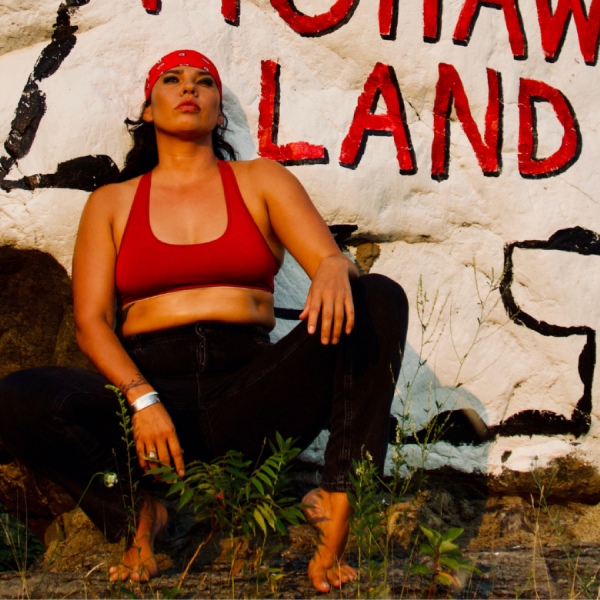
Lindsay Katsitsakatste Delaronde is a Haudenosaunee woman from Kahnawà:ke and a member of the Wolf Clan. She is currently enrolled as a PhD student in the Indigenous Governance program and holds the Audain Professorship in the Visual Arts Department at the University of Victoria. As a multidisciplinary artist and scholar, she engages in Indigenous arts, culture and governance theory and research with the consciousness of the Haudenosaunee Confederacy woven into the essence of her being.
As a descendant of those who once built palisades, raised longhouses and pounded corn, she is not separate from these cosmologies and teachings — she is their living, embodied constellation. She carries forward matrilineal knowledge, cultural resilience and land-based traditions that have sustained her people for generations. This lineage shapes both her academic research and her artistic practice.
She holds a Bachelor of Fine Arts from Emily Carr Institute of Art & Design, a Master of Fine Arts from the University of Victoria and a Master’s degree in Indigenous Communities Counselling Psychology, also from UVic. Her interdisciplinary education informs an artistic practice that is embodied, relational and deeply attentive to emotional, cultural, spiritual and land-based ways of knowing.
Her artistic practice focuses on Indigenous dance and theatre, land-based dramaturgy, embodiment, performance, collaborative process and decolonial methodologies. Through these practices, she explores the somatics of sovereignty, restores relational understanding and reimagines Indigenous ways of making through ethical, relational and culturally grounded approaches. Her work draws upon Indigenous aesthetics shaped by Haudenosaunee epistemologies, engaging themes of identity, politics, healing, resurgence, renewal, social responsibility and human rights.
She weaves culture, art, history, ceremony, healing, spirituality, breath, song, movement, human development and mindfulness into the tapestry of the creative process to support the re-visioning of Indigenous futurities of hope and beauty. Transcending the intergenerational soul wound through the impasse of the radical creative spirit is what she strives to offer in her work.
About Regina de Miguel

Regina de Miguel is a filmmaker and interdisciplinary artist whose work explores how imaginaries, violence and knowledge are produced, inherited and materially grounded in territories understood as geotraumatic sites. Through films, installations and hybrid projects, she questions the supposed neutrality of scientific images and devices, bringing maps, models, archives and data visualizations into friction with speculative and narrative strategies. Writing and voice play a structural role, opening fissures in dominant languages and rehearsing alliances between human and non-human agencies. Her work has been shown internationally and is held in collections such as TBA21, Fundación“la Caixa” and Museo Reina Sofía.
About Andrés Ramírez Gaviria
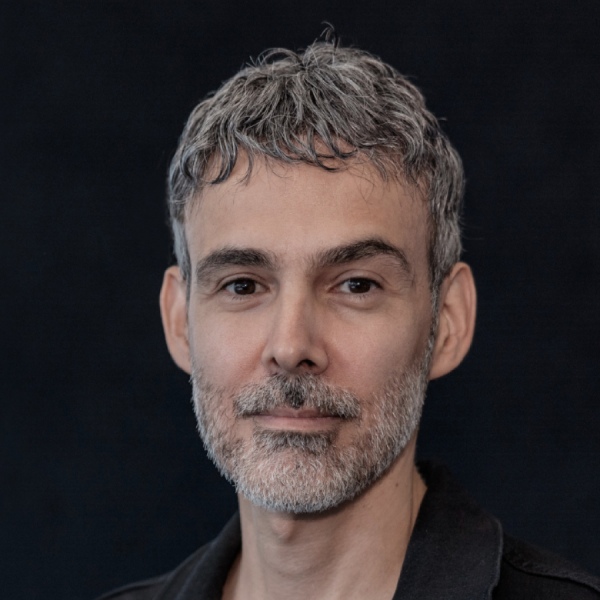
Andrés Ramírez Gaviria is an artist born in Bogotá, Colombia, and based in Vienna, Austria. His work explores intersecting histories of science, philosophy, technology, communication, mysticism, programming, language and translation. His practice reconfigures cultural and intellectual motifs through methodologies that propose alternative modes of perception and thought. Employing strategies such as reenactment, appropriation, telepathy and transference, Gaviria highlights points of tension and dialogue between contemporary experience and shifting interpretations of historical knowledge.
His work has been exhibited at Kunsthaus Graz, Kunsthaus Dresden, BA-CA Kunstforum and BAWAG Contemporary in Vienna, Lentos Museum in Linz, GAMeC in Bergamo, the Caribbean Biennial in Santo Domingo, the Museum of Modern Art and the Museo de Arte del Banco de la República in Bogotá, La Casa Encendida in Madrid, as well as Sonambiente and Transmediale in Berlin, among others. He has participated in residencies at MuseumsQuartier in Vienna and the International Studio & Curatorial Program (ISCP) in New York.
Gaviria is the recipient of the Transmediale.06 Award and the Cisneros Fontanals Art Foundation Emerging Artist Award. Two monographs — Between Forms of Representation and Interpretation (Onomatopee, 2012) and A Line, However Short, Has an Infinite Number of Points (Triton, 2016) — have been published on his work. His writing has appeared in Leonardo, #Errata, Flash Art International and other publications.
In 2014, he co-founded Sigmund, and in 2017 Anna, two non-profit exhibition spaces in Vienna, together with Norbert Pfaffenbichler. He also collaborates with Elisabeth Kihlström and Yuki Higashino on the journal Agency. Gaviria studied media theory at the University of Applied Arts Vienna and holds a BFA from Boston University and an MA from the Winchester School of Art, University of Southampton.
Dates & Times
Tickets
Venue
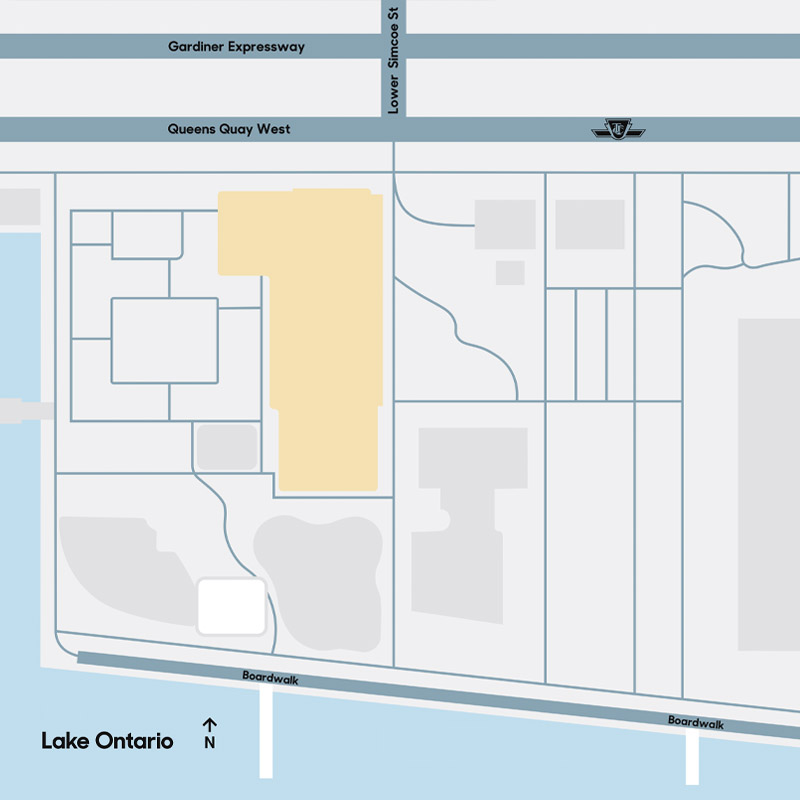
235 Queens Quay West
Toronto, ON
More Related Events
Co-presented with

Supported by